I had a great time this weekend hacking with friends and then filming The Fat Man and Circuit Girl show. George presented a hack of his Miko keyboard where he bravely sawed it in half, twisted wires around, flipped screens and moved the control surfaces around. He also showed the follow up to his giant metal re-verb and how it’s now permanently wired in that bathroom of his studio.
Monty, Ionn and I spent all weekend trying to cut record grooves into the front surface of CDs using my table top lathe. The first attempt was with a 3 ft arm attached to a speaker on one end, pivoting 2 inches from the other end at the tool post and then attached to an exacto knife held in the tool holder, so it will flex with the audio. We could see the blade moving with the music, but it wandered badly when we tried cutting the spiral grooves. Next we tried attaching a exacto blade and feeding the audio into a chart recorder galvanometer that Monty had brought with him for a laser projection project. This seemed promising, but again the blade wandered too much. Finally we attached a carbide lathe tool insert, so it rotated near the axis of the galvanometer and got some audio recorded, but the chatter and rough cut in the groove made the quality about 80% white noise. Lesson learned here is that we thought records would be easy to make, but turns out to be very difficult.
I’ve been interested in high energy particles/radiation, since I was a kid and used to spend a lot of time reading about the subject, but never considered experimenting with it until recently. Six months ago a good friend gave me a Geiger counter and said that every nerd needed at least one around and that this was one of his spares. ( Woz and him would pull it out on planes to show passengers how much radiation they were getting) Then last week I stumbled onto this great site with historical experiments and the spinthariscope caught my attention http://www.lateralscience.co.uk/spin/index.html In the article they said you could make one from the americium in a smoke detector and ZnS:Cu (glow powder). I figured it would be fairly safe to make one after reading that americium in smoke detectors emit low level alpha particle and I had several sources of ZnS around.
We picked up several smoke detectors Saturday and when we got back tested them with the geiger counter which didn’t tick much more than normal background radiation. Ionn cut the lid off of the sensor that contained the americium, which consisted of two thin metal straps holding a steel lid down and a vented plastic cylinder . Holding the geiger counter over this didn’t tick much until we got within 1 inch, which was a good sign that it really was only emitting alpha radiation. When the counter was close enough to be vigorously ticking we could block almost all of the alpha radiation by slipping a sheet of paper between the sample and the counter.
I grabbed a small CRT from a camcorder viewfinder, busted the face off, placed it over the sample, placed it on a microscope and then we moved into a dark room in hope to see the phosphors light up when struck by radiation, but even after letting our eyes adjust we didn’t see anything. Next I pulled some ZnS:CU glow power from the Discovery Crystals kit and sprinkled it on the sample, when back to the dark area and fairly quickly we could see what looked like a mini lightning storm in the pile of phosphor. We then put a drop of alcohol on the phosphor, which flattened it out and gave a bit better result. Under lower magnification the excited phosphor looked like the snow you see on the now outdated analog TV and under higher magnification it looks like little sparks jumping around.
We tried to place the sample and phosphor directly on the glass of a web cameras image sensor and make a contact microscope, but the intensity of the excited phosphor is too low for the sensor to pick up. This was a very fun and exciting project for me and I hope I can find a more sensitive CCD camera to finish it later.
This week I continued my short FPGA tutorial series with switch de-bouncing and edge detection. It’s not the most exciting project, but both are essential and used all over designs. I’m looking forward to finishing the little Arduino compatible pin out FPGA board this week and when we can start getting into higher level designs.
George had to leave a bit early, so impromtuously talked about my plans for a c64 for Seth of 8bit Weapon. I plan on putting a small FPGA board in between a secondary SID sound chip and the c64. This will allow me to control the clocking of the secondary SID, so it can be de-tuned slightly, but can handle the clock crossing between the 1.02mhz of the NTSC C64. By sending the same commands to both the primary and de-tuned SID I believe this will generate some nice sounds.
Monty hit a home run on this weeks show with his text2speech and the talking parrot hack. He extracted text from an IRC client(this is where our live chat happens during the show), parsed it with perl to select certain users, assign them voices, directed it to the Macintosh speech synthesizer and then fed the audio into an animatronic parrot. The parrot got old after a little while, but the chat room spent hours talking back and forth in they’re funny voices. At one point I was laughing so hard I started to cry! Thanks Monty.
Thanks to everyone who helped out at the NW Nerd Lair this weekend (Trish,Ionn, Monty, Steve) and all the viewers that tuned in for the pre and post show.
Visit www.fatmanandcircuitgirl.com for the videos, forums and other news
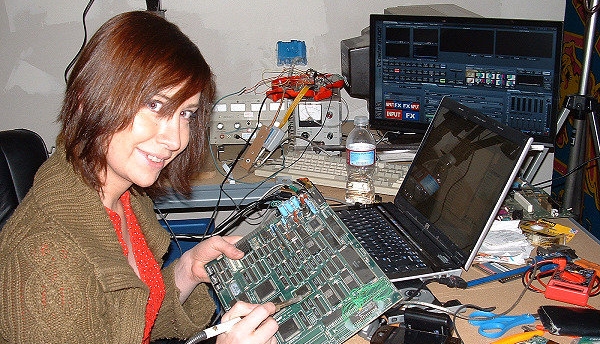
Yay! Jeri’s taking notes. Ralph Baer will be proud.
I think we need to better constrain the up-down movement of the groove-cutting stylus while still allowing side-side movement.
I’ll post the steps I took to implement irc-to-parrot on the fatmanandcircuitgirl forums.
Thanks for the fun weekend!
Nice to see this up. What kind of microscope do you have?
-Brooke
It was Monty’s microscope. Not too powerful. Nothing like your geek toys.
Thanks for another fun show. I guess I wasn’t awake when you tried it, but I have been trying to figure out why my circuit wouldn’t behave, since I just built it again and it worked. I wonder if it is to do with the type of logic chip, since I am relying on characteristcs that are not well specified, so probably not all types are suitable. I used a 74HCT74 because I had one, but I think a 74HC74 would be better because the input threshold would be closer to midrail. I limited the current to the speaker with a 100 Ohm resistor and blocked the DC to the speaker with a 1000uF cap. I used a bigger input cap than you did, but that shouldn’t make any difference. Also I added big decoupling caps but I’m sure you would have too. I provided the audio signal from the headphone socket of a Discman on full volume.
FPGA tutorial? Jeri, where would I find this wonderful resource?
Yes, its me on the wonderful world of the “guess who” network.
Hoping to show up this weekend but won’t have any hacks. Just plain too busy. Travel here, travel there.
Nice caption of last weeks hackjam and show. Though I missed Wednesday’s recording. Simple request? Please post it in the forums next time??? I heard it was a wonderful show on Wednesday night.
Ah, nice. I found out its a Stereo Zoom Microscope. If you ever need any higher magnification pics, just let me know. Too bad I couldnt ‘borrow’ some source here. We have some AM241-Be(19 Ci) and Cs-137(2Ci) here right now. That will surely make your meter tick!
http://www.shellac.org/recording/record3.html
You’ll have to adapt certain things from this document for cutting on a cd surface - but this may have some ideas you can use.
Thanks for the link. We’ll have to try to use a hot stylus in the next experiments.
-Jer
I think most Geiger counters cannot detect Alpha, but since Americium emits (much less) Gamma also, it can make some clicks on a counter - the Alpha would be a steady stream however.
I’d look into Thorium mantles and Radium/Uranium paints&glazes for Beta/Gamma test sources.
Awesome videos, Jeri. As an aspiring young engineer, I wonder if you might have some words to share about staying organized, goal setting, pacing yourself … basically, managing yourself. I am enthusiastic and love to tackle problems, analyze, focus, and work hard but often find myself getting maybe 75% through finishing something off well enough for others to use. Sometimes I get that “man, why am I trying to do *this*?” feeling and then lose motivation. I guess you could say I’m short on follow-through and it’s catching up with me! You seem to have lots of follow-through and manage yourself well. Are these traits that can be learned? Or am I hopeless?? Keep up the great work. I am learning a lot!
Jeri - thanks for doing so much interesting stuff. It’s really quite impressive. If I can offer a comment, you had a really short video on youtube with a homemade transistor (?!) A longer more elaborated version would be deeply appreciated.